
Address
Building 34, Taixing Industrial Zone, Hongxing Community, Songgang Street, Bao’an District, Shenzhen, Guangdong 518105, China



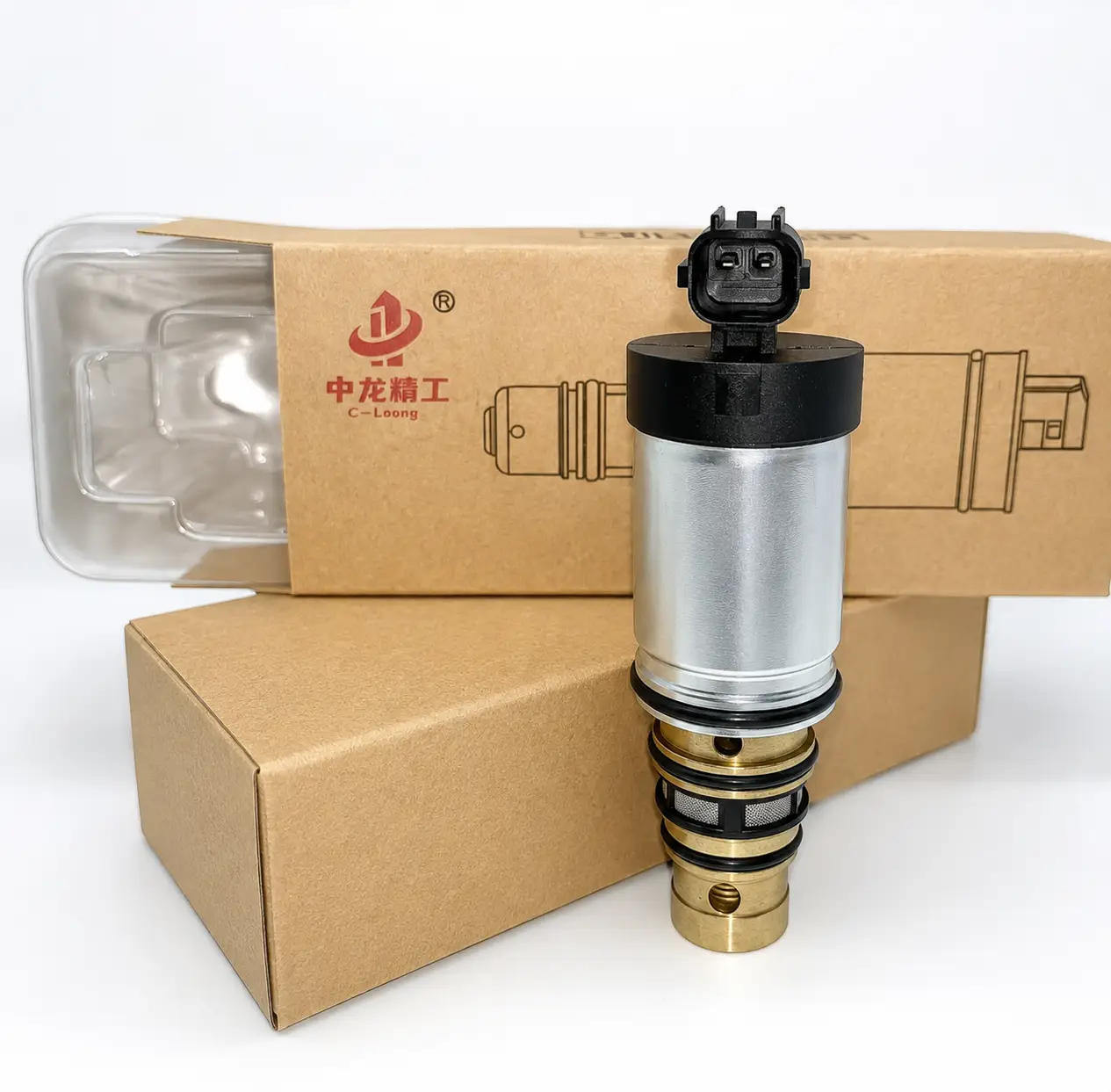
Everything You Need to Know About the AC Compressor Control Valve
By C-Loong Precision Industry (Shenzhen) Co., Ltd
If the AC blows warm air, cools weakly, or cools one day and not the next, the cause may be the AC compressor control valve, the part inside the compressor that sets how much it pumps. If nothing is done, the cabin stays warm. If the cause is guessed at, the repair gets more expensive: a compressor is replaced when only the valve had failed, or a new valve goes in and the warm air comes back because the cause was somewhere else. For a workshop that means a comeback job. For a parts seller it means a returned valve that was never faulty.
The valve is fitted to variable displacement compressors. When it stops responding, the compressor can keep turning without building the pressure needed to cool. The same complaints also come from low refrigerant, a wiring or connector fault, the wrong type of valve, or a fault in another part of the system, so the valve has to be tested before anything is replaced.
This guide shows how to tell a failed valve from those other faults, how to test it, and how to match a replacement AC compressor control valve to the compressor. You will also see the same part called an AC compressor solenoid valve, an electronic control valve (ECV) on Kia, or an N280 valve on Volkswagen and Audi.
Page Contents
Product Categories
What Does an AC Compressor Control Valve Do?
The function of an AC compressor control valve is to set how hard the compressor works, so that it delivers the cooling the cabin needs at that moment and no more. When the cabin is hot and the driver asks for full cooling, the valve lets the compressor pump at high output. As the cabin comes down to the set temperature, the valve cuts the output back (MAHLE).
The valve can bring the compressor’s output down to a few percent. That is why some compressors are built without a clutch and turn whenever the engine runs, while others keep a clutch alongside the valve (MAHLE). Either way, it is the valve, not the clutch, that decides how much the compressor pumps. This is worth remembering on a clutchless compressor, where a turning pulley does not mean the compressor is pumping.
Control valves belong to variable displacement compressors driven by the engine belt. The control valves we supply are all electronically controlled and are for petrol and diesel vehicles.
How Does an AC Compressor Control Valve Work?
Knowing how an AC compressor control valve works explains how it fails. The valve never moves the pistons itself. It changes a pressure inside the compressor, and that pressure does the work.
In these compressors the pistons are driven by a swash plate that sits at an angle on the shaft. The steeper the angle, the further each piston travels and the more refrigerant the compressor pumps on every turn. The angle is not fixed. It shifts with the pressure acting on the plate, and it is the control valve that sets that pressure (Delphi). When the pressure in the compressor’s crank chamber rises, the plate flattens and output falls. When the pressure drops, the plate tilts further and output rises.
An electronically controlled valve gets its orders from the climate control unit. The unit works from the outside temperature, the temperature the driver has set, the high and low pressures in the system, engine speed and engine load, and sends the valve a pulse width modulated signal (MAHLE). Whether a stronger signal means more output or less depends on the compressor design, which matters when you read test values later.
This is why a valve that sticks, clogs or loses its signal leaves the swash plate at the wrong angle. The compressor keeps turning, but it pumps too little or does not respond when the demand changes.
Mechanical and Electronic Valves: How Each Is Controlled
There are two types of AC compressor control valve, and they are not interchangeable.
A mechanical valve has no electrical connection. It works on its own inside the compressor, responding to the pressure on the suction side, and it is found on compressors with a clutch, which is the older arrangement.
An electronic valve has a coil and a connector and is driven by the climate control unit. It is also called an externally controlled valve, a name that refers to where the control signal comes from. The valve itself is still built into the compressor. Electronic valves are found on clutchless compressors and on some compressors that keep a clutch (MAHLE).
A clutch is a feature of the compressor, not a type of valve. The symptoms and test methods in the rest of this guide deal with electronic valves.
Where Is the AC Compressor Control Valve Located?
The AC compressor control valve is located in the compressor itself. One end shows on the outside of the compressor body, where the wiring plugs in. It is not fitted in a refrigerant line, and it is not a separate part somewhere else in the engine bay (MAHLE).
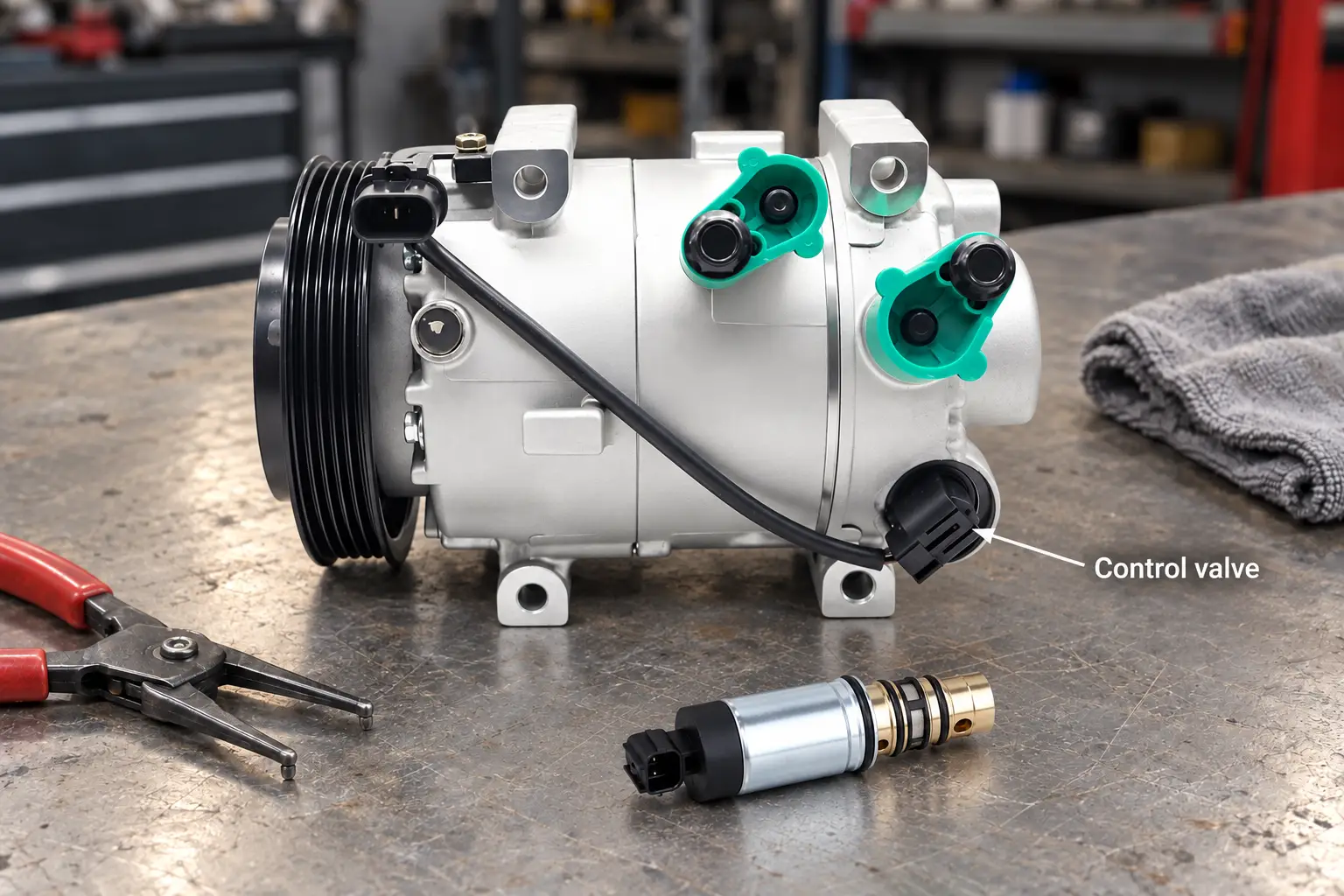
This matters before any testing starts, because every electrical check on the valve begins at its connector. Looking for the valve along the AC lines wastes time, and a reading taken at the wrong connector says nothing about the valve.
How to Find the Valve on the Vehicle
Start at the compressor on the engine’s belt drive and follow the wiring to the compressor body. On some compressors the plug connects straight to the valve. On others a short lead runs from the valve to a plug nearby. A compressor with a clutch also has a clutch coil circuit, and some use a three-pin connector that carries both the valve and the clutch (OEM bulletin), so it is worth checking the wiring diagram before testing at the pins.
The valve does not sit in the same place on every compressor, and there is no single name for the spot. On Land Rover and Range Rover models, for example, it is in the compressor cylinder head (Jaguar Land Rover). For a specific vehicle, the service information shows the exact position.
How the Valve Is Held in the Compressor
What shows on the outside is only the end of the valve. The rest sits in a bore in the compressor, sealed with O-rings and held by a circlip or snap ring (Volkswagen, Kia). The valve on the Kia Sportage, for example, carries three O-rings, and they are coated with compressor oil before the valve goes in.
Because the valve seals inside that bore, cleanliness matters whenever a valve is changed. The bore and the circlip groove have to be clean, because dirt or damage there can ruin the new valve or the compressor (Volkswagen).
Can You Reach the Valve With the Compressor on the Engine?
For testing, yes. The checks are made at the connector, with the valve left in the compressor. Taking the valve out is a different matter. It is sealed into the compressor, so the refrigerant has to be recovered first, and on some vehicles the compressor has to come off the engine before the valve can be removed (OEM bulletin).
Symptoms of a Bad AC Compressor Control Valve
The symptoms of a bad AC compressor control valve are warm air from the vents, weak cooling, cooling that comes and goes, warm air at idle, and in some cases noise from the compressor. Each of them has been recorded on production vehicles, and where a detail applies only to certain vehicles, those vehicles are named.
None of these symptoms proves that the valve is at fault. Each has other possible causes, and treating a symptom as a diagnosis is how sound compressors and sound valves end up replaced. Use this section to decide whether the valve belongs on the list of suspects, and then test it.
| Symptom | What the driver notices |
|---|---|
| AC blows warm air | The compressor is turning, but the vents still blow warm |
| Weak cooling | The system cools, but not enough |
| Cooling that comes and goes | Cold air, then warm, then cold again |
| Warm air at idle | Warm air while the vehicle is standing |
| Noise from the compressor | A grinding or groaning noise |
AC Blows Warm Air
The AC is switched on and the fan is blowing, but the air from the vents is not cooled at all. On a clutchless compressor the pulley is still turning, which makes it look as if the compressor is working.
A bad control valve causes this when it stops regulating and leaves the compressor pumping next to nothing. The compressor turns, but no pressure builds and nothing is cooled. This happened on the 2015 Audi A3 and the 2015 to 2016 Volkswagen Golf and GTI, where the valve became obstructed inside. With the AC running, the high side and low side pressures stayed equal, because the compressor was not generating any pressure (Volkswagen, Audi).
Two details from those cases help separate a bad valve from other causes of warm air. The control unit was still commanding the valve normally, so the control side was not the cause. No fault codes were stored either, so an empty fault memory does not clear the valve.
Weak Cooling
The system cools, but not enough. This is what happens when the valve still works but cannot work fully: the compressor pumps, yet it cannot reach the output the control unit is asking for (Volkswagen, OEM bulletin).
A quick way to put a number on weak cooling is to idle the engine with the temperature at its lowest setting and the fan on high, wait five minutes and measure the air at a centre vent. On the 2017 to 2019 Kia Sportage, 50°F (10°C) or more is abnormal (Kia). That figure applies to the Sportage, so use the value in the service information for the vehicle you are testing.
Cooling That Comes and Goes
The AC cools properly, then blows warm, then recovers. A valve that is worn or sticking behaves this way because it cannot follow changes in demand. The vent temperature cycles between warm and cold, and the cabin ends up too cold or too hot (Jaguar Land Rover, Land Rover).
A valve that is partly obstructed can also fail intermittently. On the Volkswagen and Audi models above, both the weak cooling and the loss of cooling came and went (Volkswagen).
Warm Air at Idle
The AC blows warm while the vehicle stands at idle. On the 2014 to 2015 Toyota Corolla the fault came and went. While it was present, the control current to the compressor read 0.7 A or higher, yet the pressure stayed low and the evaporator temperature climbed. The compressor was being told to work and was not responding. The repair was an updated compressor, so the valve was not singled out as the cause (Toyota).
On the 2017 to 2019 Kia Sportage, intermittent failure at idle is the starting point of the diagnosis, and the control valve is one of the parts replaced, depending on the production date (Kia).
Warm air at idle has other causes as well, including a seal inside the compressor (GM). For that reason this symptom points to the compressor’s output control as a whole, and only testing shows whether the valve is the part at fault.
Noise From the Compressor
The system still cools, but the compressor makes a grinding or groaning noise. On the Volkswagen and Audi models above, this came from the valve losing control of the refrigerant. The noise can change with the climate control setting and is often more noticeable with the system switched off (Volkswagen). The link between this noise and the valve is documented for those vehicles only.
What Causes an AC Compressor Control Valve to Fail?
The documented causes of AC compressor control valve failure fall into four groups: debris blocks the valve, the wrong oil clogs it, the valve itself wears or sticks, or its coil fails.
The cause decides whether a new valve will last. In the first two cases the valve is the victim of a problem elsewhere in the system. If a new valve is fitted without dealing with that problem, it can block again. The customer then comes back with the same complaint, and a sound valve is returned as faulty.
Debris and Contamination in the System
Metal particles and dirt travel with the refrigerant and oil, lodge in the valve and block it partly or completely. The valve then cannot regulate, and the compressor stops working properly.
The compressor itself is one source of these particles. A compressor that runs for a long time with too little refrigerant, for example because of a leak, is poorly cooled and poorly lubricated. Its parts wear, and the metal they shed can clog the control valve. Compressors with a control valve are particularly sensitive to a shortage of refrigerant or oil (MAHLE).
Service work can have the same effect. Evacuating and refilling a system can loosen dirt and metal particles and carry them into the control valve, especially when the receiver-drier is old or the system was underfilled (MAHLE). After a compressor failure, fine particles mix with the oil and travel through the whole system in both directions. If the circuit is not flushed and the required parts are not all replaced, the dirt goes round again and clogs the control valve of the new compressor (DENSO, Sanden).
Moisture is a contaminant as well. It can combine with the refrigerant to form an acidic solution that corrodes the parts inside the compressor (Sanden). When the old valve comes out, check the valve bore for corrosion as well as debris, and inspect the filter screen on the valve (Volkswagen).
A blocked or corroded valve is therefore a reason to look at the rest of the system.
The Wrong Oil or Mixed Oils
Oil that does not belong in the system can block the valve without any metal in it. PAO oil does not mix with PAG oil or with DENSO’s ND oils. When they meet, a paraffin-like substance forms, and it blocks the compressor control valve or the refrigerant circuit (DENSO).
Compressor makers specify oil by model. Sanden, for example, lists one PAG oil for its PXE and PXV compressors and a different one for other models, and using other oils voids the warranty (Sanden).
The safe rule is to use the oil type and quantity the compressor manufacturer specifies, and to treat a valve coated in a waxy deposit as evidence of an oil problem.
Wear and Sticking Inside the Valve
Sometimes the valve itself is the fault. A worn valve can give abnormal system pressures (Jaguar), a valve that is worn out or sticking can make the vent temperature cycle (Jaguar Land Rover), and a valve that becomes stuck cannot respond to changing demand at all (Land Rover).
Manufacturers do not publish what wears or why the valve sticks. For a worn valve the repair is a new valve, which Jaguar and Land Rover supply as a kit for the models concerned.
A Failed Coil
An electronic valve works through a coil, and a valve with a failed coil cannot respond to the control unit however clean the system is. The way to check it is to measure the coil’s resistance. When the reading falls outside the range given for the vehicle, the valve is replaced, not the compressor (OEM bulletin).
An electrical fault at the valve is not always a fault in the valve. On the 2019 to 2023 Audi Q8, the AC stopped working and a fault code was stored for an open circuit or short circuit at the compressor regulator valve, which is Audi’s name for the control valve. The cause turned out to be the wiring: the harness to the compressor connector was too short, so the wires stretched, broke or pulled out of the connector. The harness was repaired and the valve stayed in place (Audi). It is worth checking the wiring and the connector before condemning the coil.
A resistance reading within range does not prove the valve is healthy. It shows only that the coil is intact, and the valve can still be blocked or stuck, which is why the test section below uses more than one check.
How to Test an AC Compressor Control Valve
To test an AC compressor control valve, first rule out the faults that imitate it. Then check four things: the control signal reaching the valve, the resistance of its coil, how the compressor responds when the valve is driven directly, and the pressures on the high and low sides. That is how to test an AC compressor control valve without guessing.
No single check is enough. Each one proves part of the picture and leaves the rest open, so a valve should be condemned only when the results agree. Skip a step and you risk fitting a new part that changes nothing.
All of these checks are made with the valve in the compressor and the system charged, so nothing has to be opened.
Before You Test: Faults to Rule Out
Four faults produce the same complaints as a bad valve, and each should be checked before the valve.
- Low refrigerant or a leak. Make sure the system holds its full charge before any compressor diagnosis (Ford). If the charge is out of specification, recharge, leak test and repeat the pressure test (OEM bulletin).
- A wiring or connector fault. Check the harness and connectors between the climate control unit and the compressor, and look at the valve pins for bending or poor contact (OEM bulletin).
- The wrong type of valve or compressor. On some DENSO compressors fitted to Mercedes-Benz, the valve either contains a diode or relies on one in the control unit. If a unit with the diode in the valve is replaced by one without it, the compressor will not operate (DENSO).
- Another part of the system. On some 2017 to 2019 Kia Sportage builds, the repair for poor cooling is the evaporator temperature sensor alone (Kia). On the Sanden compressors in the 2015 to 2016 Volkswagen Golf and GTI, a released torque limiter, the overload protection in the pulley, means the valve is not at fault and the compressor has to be replaced (Volkswagen).
If you sell control valves and a customer returns one as faulty, these are the four things to ask about. Send us the vehicle, the compressor label and the test results that came with the return through our contact page, and we will help you work out whether the valve was the cause.
Check the Control Signal
This check shows whether the control unit is asking the valve to work.
With a scan tool, read the current the control unit is sending to the valve. Run the engine at idle, set the climate control to full cold and full fan, switch recirculation on and close the windows. On the 2015 Audi A3, a normal reading under a cooling request is 0.400 A to 0.680 A (Audi). Use the value given for the vehicle you are testing.
Not every scan tool can read this value. The alternative is an oscilloscope at the compressor connector, where the signal appears as a square wave (MAHLE). On the 2015 Audi A3 and on Volkswagen Jetta and Passat models with an N280 valve, a good signal at maximum cooling is a square wave between 75% and 100% (Volkswagen, Audi).
A normal reading on the scan tool shows that the control unit is commanding the valve. A normal signal measured at the compressor connector shows that the wiring is delivering that command as well. Neither says anything about the valve itself. If the signal changes with demand but the vent temperature does not, the fault is in the valve or the compressor. If there is no signal, look upstream at the wiring, the sensors and the control unit before blaming the valve.
Measure the Coil Resistance
This check shows whether the coil in the valve is intact.
Unplug the connector and measure the resistance across the valve terminals. Compare the reading with the range given for that vehicle. As an example, one manufacturer accepts 8 to 14 ohms and replaces the valve, not the compressor, when the reading is lower or higher (OEM bulletin). That range applies to the vehicles in that bulletin and is not a general standard.
A reading in range proves only that the coil is not open or shorted, and the valve can still be blocked or stuck.
Drive the Valve Directly With a Tester
This check separates a fault in the valve and compressor from a fault in the vehicle controls.
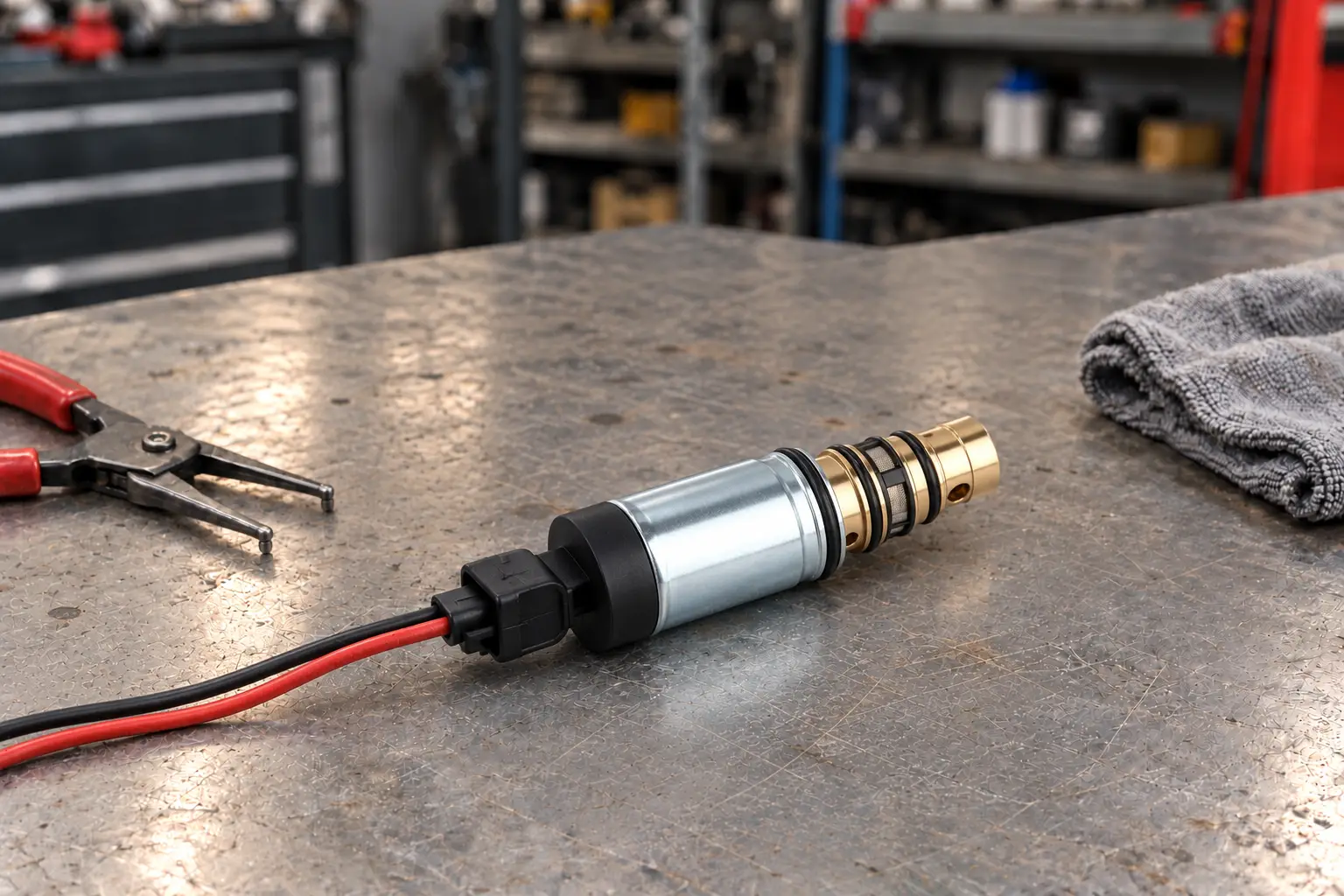
A control valve tester connects to the valve in place of the vehicle harness and drives it directly, bypassing the control unit. The valve is stepped through its range while you watch the system pressures and the vent temperature (Four Seasons). Ford issued a tester of this kind to its US dealers to cut down misdiagnosis and unnecessary compressor replacement (Ford).
If the pressures respond when the valve is driven directly, the valve and the compressor can do their job, and the fault is in the wiring or the control side. If the compressor still does not pump, the cause is the valve, the compressor or the basic refrigerant system.
Watch the pressures and temperatures the whole time, because driving the compressor without monitoring it can cause serious damage (Four Seasons). Keep to the time limit of the tool you are using. One manufacturer limits its kit to 30 seconds, because the evaporator or the expansion valve may freeze and distort the gauge readings (OEM bulletin).
Compare the High and Low Side Pressures
This check shows whether the compressor is building pressure.
Connect gauges and run the system at maximum cooling. A compressor that is not pumping shows it in the gap between the two sides, but the pattern differs by vehicle:
- On the 2015 to 2016 Volkswagen Golf and GTI with an obstructed valve, the high and low sides read the same (Volkswagen).
- On the 2017 to 2019 Kia Sportage, an inoperative compressor leaves a difference of only 2 to 3 bar (29 to 44 psi) (Kia).
- On Jaguar models with a worn valve, the high side reads low and the low side reads high while the clutch, where fitted, works properly (Jaguar).
As a general guide for compressors with a control valve, the low side sits at about 2 bar and stays constant when checked at 2,000 to 2,500 rpm (MAHLE).
Abnormal pressures prove that the compressor is not pumping as it should, but they do not say whether the valve or the compressor is to blame. Normal pressures mean the compressor and the valve were working at the time of the test. If the complaint comes and goes, repeat the check while the fault is present before ruling the valve out.
What the Test Results Mean
| What you find | What it tells you | What to do next |
|---|---|---|
| Refrigerant charge is low | The other results cannot be trusted yet | Recharge, leak test and test again |
| No control signal at the valve connector | The fault is before the valve | Check the wiring, the sensors and the control unit |
| A fault code for the valve circuit | There is an electrical fault in the circuit, which may be the wiring | Check the harness and the connector first |
| Signal normal, coil resistance out of range | The coil has failed | Replace the valve, where it is supplied separately |
| Signal normal, resistance in range, compressor not building pressure | The valve is blocked or stuck, or the compressor is damaged | Drive the valve directly, then inspect the valve bore and filter screen |
| Pressures respond when the valve is driven directly, but not under vehicle control | The valve and the compressor can work | Go back to the wiring and the control side |
| Pressures do not respond even when the valve is driven directly | The valve or the compressor is at fault | Check the compressor, then remove and inspect the valve |
| Signal, resistance and pressures all normal | The valve was working during the test | If the fault comes and goes, test again while it is present. Otherwise look elsewhere in the system |
Replace the Valve or the Whole Compressor?
Replace the valve alone when three things are true: the tests point to the valve, the valve is supplied as a separate part for that compressor, and the compressor is clean inside. Replace the whole compressor when the valve bore is badly contaminated or corroded, when the compressor is damaged, or when no separate valve is offered.
Getting this wrong costs money in both directions. A compressor replaced for a failed coil is a far bigger job than the repair needed. A new valve fitted into a contaminated compressor blocks again and comes back as a warranty claim.
When Replacing the Valve Alone Is Enough
Start by confirming that a valve exists for the compressor on the vehicle. Availability changes with the compressor and even with the date. On the 2015 Audi A3, the valve could not be bought apart from the compressor in September 2014 (Audi). From 2015 an improved valve was offered for the Sanden compressor, and replacing the whole compressor was no longer necessary in most cases (Audi). That valve fits only the Sanden compressors it was made for. It does not fit other Sanden compressors or any Denso compressor (Volkswagen).
Then look at what the old valve shows when it comes out. A slight amount of debris or corrosion in the valve bore, or a few small particles on the filter screen, does not justify replacing the compressor (Volkswagen). A coil with a resistance outside its range is a reason to replace the valve and nothing else (OEM bulletin).
Follow the vehicle procedure for what else has to be done. On Volkswagen Jetta and Passat models from 2011 to 2017 with a Sanden compressor, for example, the refrigerant circuit must be flushed and the receiver-drier and expansion valve replaced whenever the valve is changed (Volkswagen). The steps, from recovering the refrigerant to checking the repair, are in our AC compressor control valve replacement guide.
When the Whole Compressor Has to Be Replaced
Replace the compressor when the valve is not the only thing wrong.
- Severe contamination in the valve bore or on the filter screen. A new valve can be damaged as it is fitted, so the compressor is replaced and the circuit is flushed (Volkswagen).
- Metal from a worn compressor. When the valve has been clogged by metal shed from the compressor itself, a new valve does not cure the fault. The compressor has to be replaced and the system cleaned (MAHLE). How far the cleaning goes depends on what is found. On DENSO compressors, black particles alone can be flushed out, but black sludge with metal particles, or leak-stop additive, cannot, and every part of the refrigerant circuit has to be replaced (DENSO).
- A released torque limiter or other mechanical damage. The valve is not at fault (Volkswagen).
- No separate valve for that compressor. If the valve is not sold on its own, replacing the compressor is the only repair.
These limits come from different manufacturers and are not identical, so use the one that applies to the compressor in front of you. If the compressor does have to be replaced, the procedure is in our car AC compressor replacement guide, and the units we supply are on our auto AC compressors page.
Other Names for the AC Compressor Control Valve
The AC compressor control valve has no single official name. Vehicle manufacturers, compressor makers and parts sellers each use their own, and all of the names below refer to the electrically operated valve built into a variable displacement compressor.
This matters when you order, because a name tells you what kind of part it is, not which valve it is. Two valves sold under the same name can differ in connector, diode and fit, so identify the valve by the compressor and treat the name as a search term only.
| Name | Where you will meet it |
|---|---|
| AC compressor control valve, compressor control valve | Parts catalogues and general use |
| External control valve | DENSO |
| Electronic control valve (ECV) | Kia, Jaguar and makers of test equipment |
| Regulating valve or regulator valve N280, also called the N280 valve | Volkswagen and Audi |
| Direct pressure sensing (DPS) valve | Jaguar Land Rover |
| Electric control valve | MAHLE |
| AC compressor solenoid valve, compressor control solenoid valve | Parts listings and workshops |
| RCV valve | Some parts listings. No manufacturer defines the abbreviation |
Two points are worth knowing. First, the letters ECV do not always stand for the same words: Kia uses both external control valve and electronic control valve for the same part. Second, EVDC, which Ford uses, is the name of a compressor type and not of the valve (Ford).
How to Identify the Right Replacement Valve
Identify a replacement AC compressor control valve by the compressor it goes into: the maker, the type and the part number on the compressor label. Then confirm the connector, the diode and the shape of the old valve. The vehicle badge alone is not enough.
A valve that looks right and fits the bore can still be wrong. It may leave the compressor dead, and the buyer learns that only after the system has been opened, recharged and tested. For a reseller, each wrong match is a return.
Start From the Compressor, Not the Vehicle Badge
The same vehicle can carry compressors from different makers. On the 2015 Audi A3, the compressor fitted at the factory was a Sanden, while later production and the replacement compressor were Denso (Audi, Audi). The control valve for the Sanden compressor does not fit any Denso compressor (Volkswagen).
Even one compressor type can differ. Two DENSO part numbers for the same compressor type have the control valve connection in different places, one at the rear and one at the top (DENSO).
The reliable starting point is therefore the label on the compressor. Note the maker, the type and the part number before looking for a valve.
Check the Connector and the Diode
On some DENSO compressors fitted to Mercedes-Benz, the valve comes in two electrical versions. One has a diode inside the valve, and the other relies on a diode in the control unit. The two are not interchangeable. If a unit with the diode in the valve is replaced by one without it, the compressor will not operate and a fault code is stored.
The connector tells them apart. Five dots on the connector, or a triangle on top of it, mark a valve with the diode inside. No marking means the diode is in the control unit (DENSO). These markings are specific to DENSO and should not be assumed for other makes.
For any valve, compare the new part with the old one before fitting. Check the number of pins and the shape of the connector, and whether the valve has a wiring lead or plugs in directly. Then compare the length of the valve and the position of the O-rings.
Control Valves by Vehicle Make
The table lists our control valves by the vehicle makes they are supplied for. Use it as a starting point, then confirm the compressor, because one make uses more than one compressor.
The full range is on our AC compressor control valve page. If the make you need is not listed, ask us, because we can source or develop a valve for it.
What to Send Your Supplier
A supplier can match a valve quickly and correctly when the request carries the right details:
- the vehicle make, model, year and engine
- a photo of the compressor label, showing the maker, the type and the part number
- photos of the old valve and its connector from more than one side
- any OE or part number you already have
- what the tests showed, if the valve is being replaced after a fault
- the models and quantities you plan to order, and the market they are for
Send these through our contact page and we check each line against the compressor before you order. If you have only part of this information, send what you have and we will tell you what else is needed.
Ordering AC Compressor Control Valves in Bulk
If you buy control valves to sell on, you can order several models together, in small quantities of each, and every valve is tested before it leaves us.
| Order terms | Details |
|---|---|
| Models per order | Any mix of models in one order |
| Minimum quantity | 20 pieces per model |
| Lead time | Usually 7 to 15 days |
| Samples | Depend on the model and the order |
| Valve type | Electronic, for petrol and diesel vehicles |
| Your own brand | Available. Our sales team confirms the details |
Most buyers start with several models at once, to see which ones sell in their market before ordering more.
We test every valve, not a sample from the batch. Each one is checked for:
- coil resistance
- insulation
- diode polarity, where the valve has a diode
- valve movement and the response when the coil is energised
- sticking
- leaks, flow and pressure response, according to the type of valve
If we do not make the model you need, we look for it. More than 15 years in this industry and our knowledge of the Chinese supply market let us find the valve that fits your requirement. We then check it again against our own production experience before it reaches you.
To start, tell us which market you sell in and which vehicles your customers drive, or send the list you are already working from, through our contact page. We will reply with the models that match, so your first order covers the vehicles that matter in your market.
FAQ
No. The control valve is inside the compressor and sets how much refrigerant the compressor pumps. The expansion valve is a separate part at the evaporator that meters the refrigerant flowing into it. They fail in different ways and are not interchangeable.
No. The valve controls the output of the compressor, and the compressor clutch connects or disconnects the compressor from the engine. Where a compressor has both, they are separate circuits, even when they share one connector. Some compressors with an electronic control valve have no clutch at all.
Yes, when the term is used for the valve on the compressor. An electronic control valve is operated by a solenoid coil, which is why parts listings call it a solenoid valve. A mechanical control valve has no coil and is not a solenoid valve.
On some vehicles, yes. On others the compressor has to come off the engine to reach the valve. In both cases the refrigerant has to be recovered first, because the valve is sealed into the compressor.
Sometimes. A valve that is blocked inside can fail with no fault code stored, and a valve of the wrong electrical type can leave a code. A code for the valve circuit can also come from damaged wiring. In short, the absence of a code does not clear the valve, and the presence of one does not condemn it.
Confirm Fit & Get a Quote
Share your OE number, vehicle model, or a photo — whatever you have. We’ll match the right part and send you pricing, MOQ, and lead time.