
Address
Building 34, Taixing Industrial Zone, Hongxing Community, Songgang Street, Bao’an District, Shenzhen, Guangdong 518105, China



AC Compressor Control Valve Replacement: When, How and What to Avoid
By C-Loong Precision Industry (Shenzhen) Co., Ltd
AC compressor control valve replacement is justified only when diagnosis has isolated a fault at an externally serviceable valve, the compressor is mechanically suitable for a valve-only repair, and the replacement valve has been confirmed for the exact application. Poor cooling alone does not meet that threshold. This guide helps A/C workshops decide whether a valve should be considered, separate that decision from part identification, prepare the system safely, complete the application-specific replacement, and verify that the original A/C problem has actually been resolved.
Page Contents
Product Categories
When Should AC Compressor Control Valve Replacement Be Considered?
Consider an A/C compressor control valve when a variable-displacement system has poor or inconsistent cooling and there is reason to investigate compressor control rather than immediately replace the complete compressor. The question often arises when the compressor is operating but system performance does not appear to follow the expected control command, or when the same cooling problem returns without a clear explanation from a basic visual inspection.
Those observations only justify further diagnosis. Low refrigerant charge, inadequate condenser airflow, drive faults, leaks, restrictions, sensor inputs, wiring issues and internal compressor damage can create similar results. On electronically controlled variable-displacement compressors, the absence of a conventional clutch can make visual observations even less conclusive. For a symptom-led diagnostic route, continue with A/C Compressor Control Valve Symptoms.
The next task is not to select a valve. It is to determine whether compressor control is the fault direction at all.
How Do You Confirm That the Control Valve, Not Another Fault, Needs Attention?
Start with the vehicle’s diagnostic and service information. Reproduce the original A/C problem under known operating conditions, then review the refrigerant-charge condition, airflow across the condenser, drive condition, electrical supply and control information, system restrictions, and any evidence of leakage or contamination. A single pressure reading, stored code or short period of weak cooling does not prove that the control valve has failed.
For electronically controlled variable-displacement compressors, diagnosis must distinguish a control-side problem from a compressor or basic refrigeration-system problem. The Four Seasons ECV diagnostic tool is one manufacturer example: its manual and automatic test modes are intended to help differentiate a vehicle-computer control issue from a compressor or refrigeration-system issue while pressures and temperatures are monitored.
This is a tool-specific example, not a universal test procedure or a reason to use one resistance, PWM or pressure value for every valve.
Once the fault direction points to compressor control, determine whether the suspected valve is externally serviceable on that compressor. A control-related fault may still require further wiring, module, refrigerant-circuit or compressor investigation. If the evidence remains incomplete, continue with Car AC Compressor Failure Symptoms rather than trial-fitting a valve.
Can the Control Valve Be Replaced Separately?
Some variable-displacement compressors use an external control valve that can be replaced separately. Others do not provide a separate service path, or require a procedure that differs by compressor design and vehicle layout. The valve location, retaining method, seals, compressor access and need to remove surrounding components are application-specific.
External location alone does not make valve-only replacement appropriate. Before proceeding, confirm that the compressor is not seized, mechanically damaged or affected by contamination that has changed the repair scope. DENSO’s compressor-failure analysis describes how wear particles, incorrect oil or additives can contribute to blockage in a control valve or elsewhere in the refrigerant circuit. This supports pausing to assess contamination; it does not create a universal rule that every contaminated system needs the same repair or a new compressor.
If the relevant vehicle or compressor procedure does not support separate replacement, or the compressor and refrigerant-circuit condition cannot be established, stop the valve-only repair decision. The next step is to define the wider repair scope, not to force a control valve into a compressor that may have another problem.
How Do You Confirm the Correct Replacement Control Valve?
Diagnosis answers whether the valve should be replaced. Identification answers which valve can be installed. These are separate decisions, and one cannot substitute for the other.
Begin with the compressor label and OE or reference number. Then compare the original valve’s connector and keying, terminal arrangement, mounting or retaining design, visible markings, sealing arrangement and any dimensions required by the applicable catalog or procedure. Vehicle make, model, year and engine can narrow the range, but they may not identify one valve with enough certainty to order it.
An aftermarket catalog can show the type of information that may distinguish a valve. The Dorman 926-027 control-valve listing, for example, includes compressor type, connector and terminal details, length, mount type, O-ring information, applications and OE cross-references. Those are catalog fields for that part, not a mandatory field list for every control valve.
Electrical similarity needs the same care as physical similarity. DENSO’s control-valve identification bulletin describes certain Mercedes-Benz DENSO compressor applications in which the diode may be located in the external valve or in the ECU. That bulletin does not apply to every compressor, but it demonstrates why a valve that looks similar cannot be assumed electrically interchangeable.
C-Loong’s parts-matching experience follows the same practical boundary: vehicle information and an overall photograph help narrow possible matches, but connector differences can exclude a visually similar control valve. Final matching should continue with the compressor label, OE or reference number, connector, original-valve photographs and any needed dimensions. This is parts-identification support, not a diagnosis of the vehicle fault.
If the identification details agree, the valve can move to replacement preparation. If they conflict or remain incomplete, pause the order and obtain clearer information rather than treating similar appearance as evidence of interchangeability.
What Should Distributors and Wholesalers Confirm Before Ordering Control Valves?
Once the control valve has been identified, a distributor or wholesaler still needs to decide whether the available information is sufficient for an order. The main risk is not only choosing the wrong valve for one vehicle. It is carrying a visually similar but electrically or mechanically different valve into stock, then discovering the mismatch after it reaches a workshop or end customer.
For each model, keep the compressor label, OE or reference number, connector details, original-valve photographs and any confirmed dimensions together with the order record. If several models are being purchased, identify each line separately rather than relying on one vehicle description or one overall product photograph for the whole order.
C-Loong can help review candidate control valves before an order proceeds. Vehicle information, compressor identification and original-part details can narrow the possible match, but final confirmation depends on the available identification data and applicable catalog information. This support helps reduce incorrect purchasing; it does not replace vehicle fault diagnosis or guarantee compatibility where the original-part information remains incomplete.
Control-valve models may be mixed in one B2B order. The usual MOQ is 20 pieces per model. Sample availability depends on the model, stock and the actual order situation. Typical lead time is 7–15 days, depending on the model, quantity, stock and order requirements. If an item is in stock and order conditions are complete, dispatch may be arranged sooner. Confirm packaging, labels and any custom-development requirements for the specific project before the order is finalized.
Once the required quantity, identification details and order conditions are clear, the replacement process can move to vehicle and refrigerant-circuit preparation.
What Else Needs to Be Prepared Before Replacing the Control Valve?
What Else Needs to Be Prepared Before Replacing the Control Valve?
Before opening the A/C system, confirm that the replacement valve is correct for the identified compressor and that the required seals, refrigerant and oil instructions are available. A new valve should not be installed with an assumed O-ring, oil type or oil quantity taken from another application. Use the vehicle repair information and compressor procedure to confirm what applies to that system.
Check whether the diagnosis found signs of contamination, abnormal oil condition or internal compressor damage. DENSO’s compressor-failure analysis explains that wear particles, incorrect oil or additives can contribute to blockage in a control valve or elsewhere in the refrigerant circuit. If the condition of the compressor or circuit remains unclear, pause the replacement rather than treating the new valve as a solution to a wider system problem.
This preparation check can also change the parts requirement. If the evidence points to internal compressor damage, a control valve alone may not be the correct repair direction; continue with Car A/C Compressors after the repair scope has been confirmed. If the problem is associated with a separately serviceable clutch, pulley or coil on a compressor design that supports that repair, review A/C Compressor Clutches instead of adding an unnecessary valve. A suspected restriction elsewhere in the refrigerant circuit also needs application-specific diagnosis before any related part, including an A/C Expansion Valve, is ordered.
For distributors and wholesalers, record this decision against each order line. It helps prevent a control valve from being quoted or stocked for a project where the confirmed repair scope has moved to another A/C component. The product category link supports further identification; it does not prove that the linked part is required for the vehicle.
Recover the refrigerant before opening the circuit. In the United States, paid MVAC service requires a Section 609-certified technician and approved refrigerant-handling equipment. Intentional refrigerant venting is prohibited under Clean Air Act Section 608. Outside the United States, follow the refrigerant-handling requirements that apply where the vehicle is serviced.
For a hybrid or electric vehicle with an electrically driven compressor, stop if the approved high-voltage procedure, oil compatibility or technician authorization is unclear. This article cannot provide one isolation process because the requirements vary by vehicle.
Proceed only when the replacement valve, seals, refrigerant handling, oil instructions, contamination assessment and relevant safety procedure are clear. If any of these remain uncertain, resolve them before disconnecting the refrigerant circuit.
How Do You Replace the Control Valve?
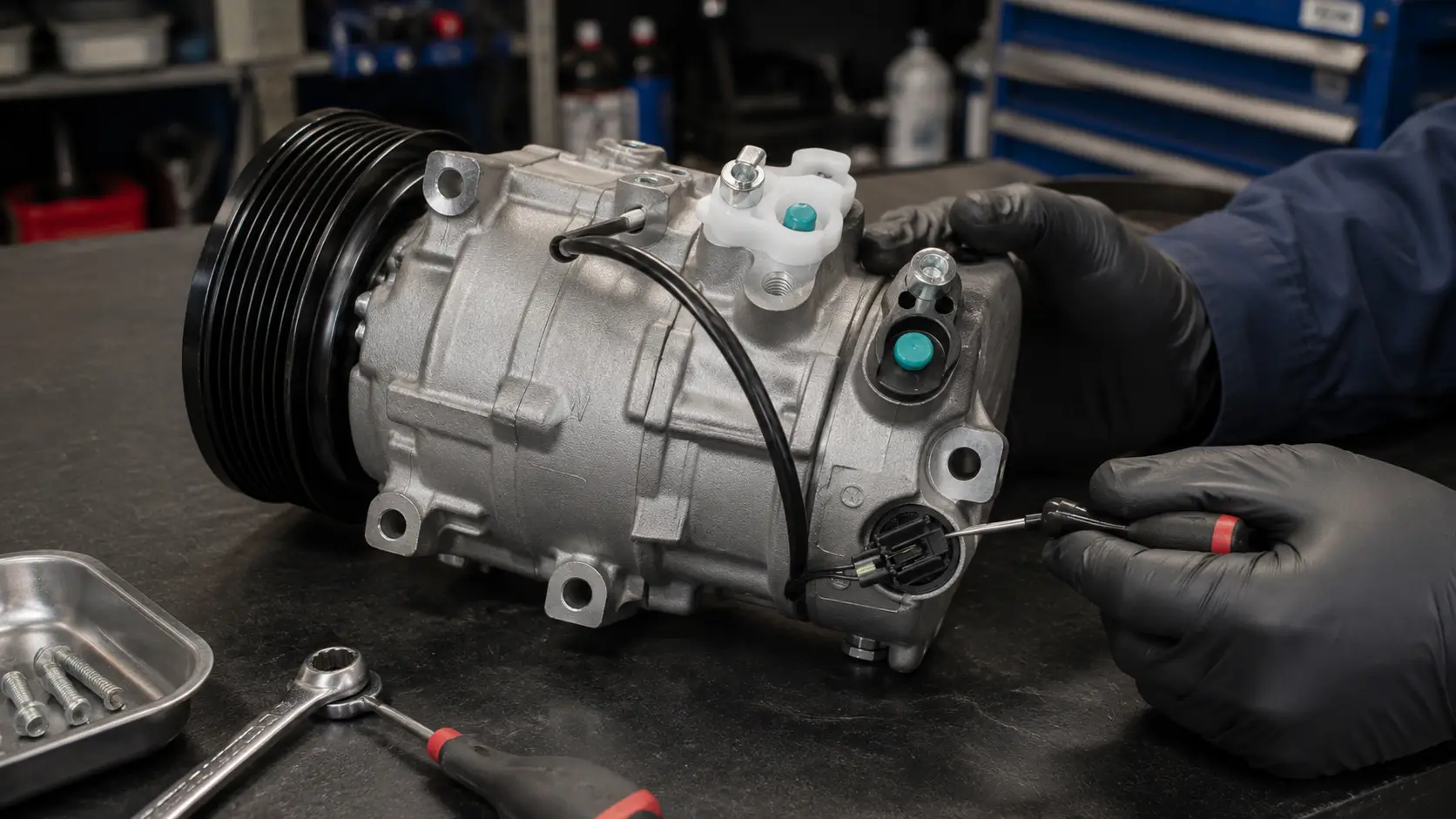
Once the system is prepared, replace the control valve by following the access route specified for that vehicle and compressor. Some applications allow the valve to be reached with the compressor installed. Others require surrounding components, or the compressor itself, to be removed first. The access method, retaining design and replacement sequence must come from the applicable repair information.
For a visual example of one real procedure, see Ford Freestyle control-valve replacement guide. It shows access, valve removal and reassembly for a 2005–2007 Ford Freestyle. It is an application-specific example, not a replacement procedure for another vehicle or compressor.
After access is available, disconnect the electrical connector and remove the retaining component in the specified order. Remove the original valve and seals only as the procedure directs. If the connector does not engage correctly, the valve cannot seat naturally, the retaining arrangement differs, or the part would need to be modified to fit, stop the work and return to the identification check.
Install the replacement valve with the specified seals and in the required orientation. Secure it with the applicable retaining method and tightening values. Do not reuse a seal where replacement is required, alter a connector, enlarge the valve bore or add hardware to compensate for a mismatch.
The replacement stage ends when the valve is seated correctly, the connector is secure and the original retaining arrangement has been restored as specified. Then complete the refrigerant-circuit restoration required for that application and verify whether the original A/C problem has been resolved.
How Do You Verify the Repair After Control Valve Replacement?
Return to the original A/C problem under relevant operating conditions. Check for leakage, abnormal noise, condenser-fan operation, compressor-control response and the pressure or temperature behavior required by the vehicle procedure. Record ambient and test conditions so that an intermittent problem can be interpreted rather than dismissed.
Do not treat a short burst of cool air as proof of a successful repair. The valve-only repair is complete only when the original problem no longer appears and the system responds normally for that application.
If cooling remains poor, do not immediately blame the replacement valve or compressor. Revisit the original diagnosis, valve identification, refrigerant charge, leakage, airflow, restrictions, contamination and control-side evidence. The earlier evidence may have been incomplete, or another condition may still be present.
What Makes a Control-Valve Line Easier to Support?
For a distributor or wholesaler, the value of adding replacement control valves is not simply having more part numbers available. A control-valve line becomes easier to support when each model can be identified clearly enough for the sales team, workshop customer and technical contact to discuss the same part without relying on a similar-looking photograph or an incomplete vehicle description.
Clear product information helps make that possible. The Auto Care Association’s overview of aftermarket data standards shows how consistent product and fitment information can make communication between manufacturers, distributors and retailers more efficient. The same principle applies to control valves: vehicle details can narrow the range, but the compressor label, OE or reference number, connector, original-valve photographs and relevant dimensions provide the evidence needed to distinguish one model from another.
A data standard does not confirm that a particular valve fits a particular vehicle. Each model still needs its own identification record and available application evidence. For a mixed product range, keep those records separate for every order line. This gives the buyer a clearer basis for catalog organization, quotation, technical follow-up and future replenishment.
Once a model can be supported with sufficient identification information, C-Loong can help review the available details to narrow possible matches. This is parts-identification support, not a diagnosis of the vehicle fault or a guarantee where the original-part information remains incomplete.
When the required models and quantities are clear, control-valve models may be mixed in one B2B order, with a usual MOQ of 20 pieces per model. Sample availability depends on the model, stock and the actual order situation. Typical lead time is 7–15 days, depending on model, quantity, stock and order requirements. If an item is in stock and order conditions are complete, dispatch may be arranged sooner. Packaging, labels and custom-development requirements should be confirmed for the specific project.
If you would like to assess a control-valve requirement for your product range, submit the available identification details and expected quantity through the text inquiry form. If closer photographs or dimensions are needed, the C-Loong team can request them by email. You can also review AC Compressor Control Valves before preparing the inquiry.
References
- Four Seasons. ECV Tool.
- DENSO. A/C Compressor Control Valve Identification Bulletin.
- DENSO. Practical Tips on A/C Service and Compressor Replacement.
- U.S. Environmental Protection Agency. Regulatory Requirements for MVAC System Servicing.
- Dorman Products. A/C Compressor Control Valve 926-027.
Confirm Fit & Get a Quote
Share your OE number, vehicle model, or a photo — whatever you have. We’ll match the right part and send you pricing, MOQ, and lead time.