
Address
Building 34, Taixing Industrial Zone, Hongxing Community, Songgang Street, Bao’an District, Shenzhen, Guangdong 518105, China



A Variable Displacement AC Compressor Adjusts Its Output Through a Control Valve, and That Changes How It Fails and How to Check It
By C-Loong Precision Industry (Shenzhen) Co., Ltd
A variable displacement AC compressor works by changing how far its pistons travel, so it pumps only as much refrigerant as the cabin needs. A small control valve sets that output. A fixed compressor pumps the same amount on every turn and has to switch on and off instead.
The same design changes how the compressor fails. Common causes of damage include low refrigerant, the wrong oil and debris that blocks the control valve. Weak cooling doesn’t always mean a bad compressor, though, and a healthy system can show gauge readings that look wrong. A good compressor can then be blamed and replaced.
The sections below explain what a variable compressor is, how it works and how to tell if a car has one. They also cover the signs of failure, what you can check without gauges and what replacing it involves. For how the compressor fits into the whole system, see our car AC compressor guide.
Page Contents
Product Categories
Key Takeaways
- A variable displacement AC compressor changes how much refrigerant it pumps on each turn by changing its piston stroke. A control valve sets the stroke.
- A variable compressor can use less energy than a comparable fixed one and keeps the cabin temperature steadier. In return, it needs a control valve and often an electronic signal.
- A clutch does not prove a compressor is fixed, because variable compressors come with or without one.
- Signs of failure can include weak cooling, cooling that swings, evaporator icing, noise and fault codes. Low refrigerant, wrong oil and debris are known causes, and weak cooling can also come from elsewhere in the system.
- C-Loong Precision Industry (Shenzhen) Co., Ltd., a manufacturer in Shenzhen, China, supplies new aftermarket car AC compressors. The minimum order is 20 units per model, and each match is confirmed by vehicle or original part number (OE number).
What Is a Variable Displacement AC Compressor?
A variable displacement AC compressor is a car air conditioning compressor that can change how much refrigerant it moves on each turn of its shaft. Displacement is that amount, given in cubic centimetres (cc). Most of these compressors use pistons, and their range can be wide.
| Compressor | Control | Displacement per turn |
|---|---|---|
| Toyota Industries 6SL12 | Internal | 8 to 120 cc[1] |
| Toyota Industries 5S10 | External | 0 to 100 cc |
| Toyota Industries 7SES17 | External | 0 to 171 cc |
A range that starts near zero lets the compressor almost stop pumping while its shaft keeps turning. A fixed compressor can’t do that, so it has to stop completely.
All of these ranges come from one mechanism: the compressor changes how far its pistons travel.
How a Variable Displacement AC Compressor Changes Its Output
A variable displacement AC compressor changes its output by changing how far its pistons travel on each turn of the shaft. Three things work together to do that: an angled plate, the pressure around it and a control valve.
Swash Plate Angle and Piston Stroke
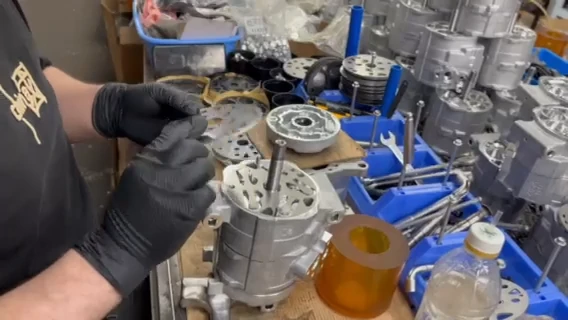
Swash plate angle sets how far the pistons travel in a variable compressor. A swash plate is a slanted disc on the shaft that pushes the pistons back and forth. A steeper angle gives a longer stroke and moves more refrigerant. A flatter angle moves less.
Pressure in the crankcase, the sealed space around the plate, is what moves it. Higher pressure pushes the plate against a spring and shortens the stroke. The spring brings it back when the pressure falls.
Swash Plate and Wobble Plate Designs
Variable piston compressors use either a swash plate or a wobble plate. Older designs such as the Delphi V5 use a wobble plate that rides on a brass bushing, while newer ones use a swash plate with a coupling joint.[2] In DENSO’s range, the 6CA is a wobble plate compressor, while the 5SE, 6SE, 7SE and 7SB use a single swash plate.
What the Control Valve Does
A control valve sets the output of a variable compressor by adjusting the crankcase pressure. On Ford’s variable compressors, the valve sits at the rear of the compressor. It keeps the evaporator, the part that cools the cabin air, at about 3 to 8 °C (37.4 to 46.4 °F), which stops it from freezing.[3]
Our AC compressor control valve guide covers this small part on its own, including how it fails.
Internal vs External Control
Internal control means the valve reacts by itself to suction pressure, the pressure of the refrigerant gas returning to the compressor. External control means an electric signal tells the valve what to do. Toyota Industries’ range has both: the 6SL12 uses internal control and the 7SES17 uses external control.
The older internal valve uses a small bellows that opens or closes a ball valve as the pressure changes. A scan tool can’t read it, which makes it harder to diagnose. An electric valve, often called a solenoid, takes its command from the air conditioning control module, and a scan tool can monitor it.
The electric signal switches on and off very fast, and the share of time it stays on is called the duty cycle. A duty cycle near 95% asks for full output. The on-time can fall to about half at highway speed, and values differ by car.[4]
The control module sets the duty cycle from several readings. These include evaporator temperature, system pressures, outside temperature, sunlight and engine coolant temperature.
What Happens When the Cabin Needs Less Cooling
The compressor reduces its output through a short chain of events when the cabin needs less cooling:
- The evaporator gets colder and the suction pressure falls.
- The control valve responds, either by itself or on a signal from the control module.
- Pressure in the crankcase rises and pushes the plate against its spring.
- The plate angle flattens, the pistons travel less and the compressor pumps less refrigerant.
The chain runs in reverse when the cabin warms up.
Why a Clutchless Compressor Keeps Turning
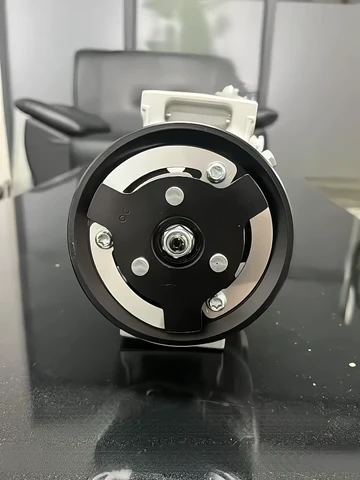
A clutchless variable compressor keeps turning whenever the engine runs, because it has no clutch to disconnect it. That is normal. With the air conditioning off, its output drops to a few percent.[5] The plate then sits at its lowest angle, where it moves very little refrigerant and uses almost no energy.
Does the Temperature Knob Change the Output?
The temperature knob affects a variable compressor differently depending on how the compressor is controlled:
- External control. On some systems, the knob’s setting is one input to the control signal. Others include evaporator air temperature and system pressure. The knob doesn’t set the output directly.
- Internal control. The valve responds to suction pressure, which follows the cooling load on the evaporator. Output follows that load, not the knob.
- Fixed compressor, for comparison. Output depends only on the clutch. When slightly warmer air is wanted, the system cools the air and then reheats it.
We can’t put a figure on the fuel saved by any one knob setting.
Carmakers choose this design because it lets the compressor match its work to the cabin.
Why Carmakers Use Variable Compressors
Carmakers use variable compressors for lower fuel use, steadier cabin temperature and a smoother load on the engine, because the compressor can pump less without switching off.
Fuel Use
A variable compressor saves fuel because it does less work when the cabin needs less cooling. External control allows finer adjustment, which can help save energy.[1]
One field study by Hyundai and Halla engineers found that a variable swash plate compressor improved fuel consumption by 6.1% to 8.6% compared with a fixed one.[6] The published summary gives neither the vehicle nor the test conditions. It is one result, not a figure for every car.
Steadier Cabin Temperature
Cabin temperature stays steadier with a variable compressor because it adjusts its cooling all the time. A fixed compressor can only run at full output or stop, so the air temperature follows those cycles. The same control protects the evaporator from freezing: a variable compressor pumps less, where a fixed one has to switch off.
Less Clutch Cycling
Clutch cycling drops with a variable compressor, which removes much of the jolt the engine feels each time a fixed compressor switches on. Not every variable compressor stops cycling, though, because some still have a clutch. Less cycling should mean less clutch and belt wear, although we have not seen a measured clutch-life figure.
How It Compares With a Fixed Compressor
A fixed compressor has fewer control parts to check when something goes wrong.
| Feature | Variable displacement | Fixed displacement |
|---|---|---|
| How output is controlled | Changes how far the pistons travel | Clutch switches it on and off |
| Control parts | Control valve, often a control module signal | Clutch circuit, no control valve |
| Clutch | With or without one | Has one |
We know of no reliable figure for which type lasts longer or costs less, or for whether clutchless compressors wear faster, so none of these appears in the table. Clutchless and clutched compressors fail at different points: clutchless ones at the pulley limiter, and clutched ones at the clutch. Variable compressors can also fail at the control valve.
The next step is working out whether a car has one.
How to Tell If a Car Has One
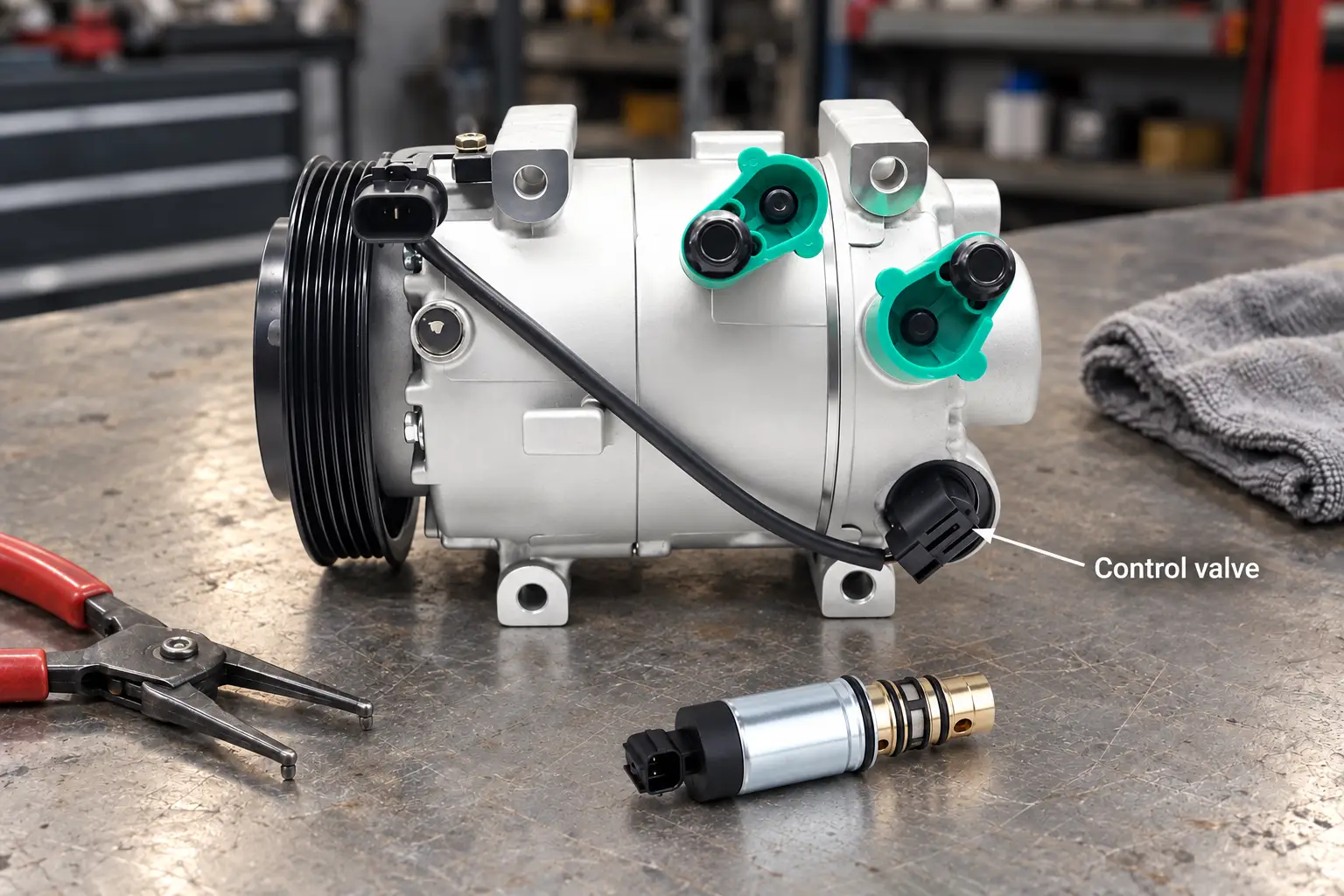
On many cars, a variable displacement compressor has a control valve at the rear, and electronic types have their own wiring for it. Not every design shows the valve from outside, so check the model code too.
Control Valve and Wiring on the Compressor
On Ford’s compressors, for example, the wired valve sits at the rear.[3] A compressor with internal control has no signal wire, so a quick look can miss it, and the model code is the better guide.
Why a Clutch Doesn’t Settle It
A clutch doesn’t settle the question, because variable compressors are made both with and without one. Ford’s electronic variable compressor engages through a clutch, for example, while the Sanden PXE works without one.
On a belt-driven compressor, no clutch points to a variable unit, since a fixed compressor needs its clutch to control the temperature. Drivers of clutchless cars also get no clutch click or engine surge when they switch the air conditioning on.
Model Code
A compressor’s model code shows its type when the brand publishes a clear naming pattern. Check the brand’s current data for any particular unit.
| Brand | Fixed displacement | Variable displacement |
|---|---|---|
| DENSO | 10PA, 10S | 5SE, 5SL, 5TS, 6SBU, 6SE, 7SB, 7SE, 6CA |
| Sanden | SD5H, SD7H, SD7B | PX series, SD6V, SD7V |
A Denso 6SEU16C AC compressor, for example, belongs to DENSO’s variable 6SE family.
To check a part number, read the model code on the compressor’s label and match it to the brand’s own list. We haven’t found a public catalogue that prints fixed or variable against every part number, so the brand or supplier may need to confirm it.
Knowing the type still doesn’t tell you the exact compressor, because that depends on the vehicle, so confirm it by vehicle or OE number. The type does make the signs of failure much easier to read.
Signs of a Failing Variable Compressor
A failing variable compressor can show up as weak or no cooling, cooling that swings, evaporator icing, noise or a fault code.[5] Each sign points to a different part of the design, as long as the cause isn’t elsewhere in the system.
| What you notice | What it can point to |
|---|---|
| Weak cooling, with the high side staying low despite a high control signal and a correct charge | Valve or solenoid stuck at a short stroke |
| Cools for a while, then blows warm as the evaporator ices up | Solenoid stuck at full output, once airflow and refrigerant level are ruled out[2] |
| Cabin swings between too cold and too hot | Sticking control valve |
| Poor cooling with a noisy compressor | Blocked regulator valve, as on some VW models with Sanden compressors[7] |
| Slow to cool after a long park | Liquid refrigerant in the compressor, which is rare |
| No compressor operation on a clutchless unit | Broken pulley limiter |
| Belt noise or a thrown belt | Cracked plastic pulley or seized compressor |
Is It Normal If It Never Cycles Off?
A variable compressor that never cycles off is usually normal. A clutchless compressor can’t cycle at all, and a variable system avoids icing by shortening the stroke, so it doesn’t need clutch cycling for that. Under a high, steady load it can stay at full stroke and behave like a conventional compressor.
Some variable designs do keep a switchable clutch, including Ford’s and some VW models, and those can still cycle. Evaporator icing is a sign of a fault once airflow and refrigerant level are ruled out. A compressor that can’t shorten its stroke keeps cooling until ice blocks the airflow, so the air turns warm after a while. To check, command the compressor with a scan tool and see whether the gauges and line temperatures change.
Why Cooling Can Take Time to Start
Cooling can start slowly on a variable compressor for several reasons:
- Liquid refrigerant after a long park. DENSO calls this rare. Liquid can collect in the compressor while the car sits, and the plate then churns it, which raises crankcase pressure and holds the output down. Some DENSO control valves add a function that dumps the liquid to the suction side.[8]
- A deliberate soft start. Some electronic compressors start at no stroke and build up gradually, which limits the load on the pulley limiter.
- Engine control limits. On electronic types, the engine control unit can force the stroke down when engine speed is too high or too low.
What Can Damage a Variable Compressor
Damage to a variable compressor is often traced to something outside it, such as low refrigerant, wrong oil or debris. These are known causes, listed in no particular order.
- Low refrigerant. Oil travels with the refrigerant, so a low level means less lubrication and cooling. The metal wear that follows can clog the control valve, and output-controlled compressors are particularly sensitive to it.[5]
- Wrong oil. PAO oil mixed into PAG forms a paraffin-like substance that can block the control valve.
- Debris. Metal from an earlier failure can spread around the system and lodge in the control valve. Brass in a filter or screen points to a worn bushing, and it means the compressor has failed or is close to it.
- Starting under vacuum. Starting the engine while the system is under vacuum can push the plate past its maximum position. The pistons then hit the drive plate and the compressor locks.
When a Clutchless Pulley Gives Way
A clutchless compressor protects the belt with a shear pin, a rubber coupling or a torque limiter in the pulley. If the compressor locks, that part breaks and the pulley spins freely. The belt keeps driving the alternator and water pump, so the engine runs normally while the air conditioning does nothing.
A broken limiter doesn’t always mean the compressor itself was at fault. Too much belt movement from a worn tensioner, a seized alternator pulley or a failed crank damper can break it. So can rough engine running or liquid refrigerant reaching the compressor.
The limiter is there so a locked compressor doesn’t leave the car stranded, and the belt keeps its job once the pulley spins free. We couldn’t find a maker’s limit on how long a car can be driven like this. The air conditioning won’t work, and the compressor usually needs replacing because the limiter often can’t be replaced separately. The cause of the break may also still be there, so have it checked soon. Belt noise or a thrown belt is more urgent, because the belt may also drive the water pump.
Signs That Don’t Point to the Compressor
Several common complaints don’t point to the compressor at all. Uneven vent temperature from side to side in direct sun is normal sun-sensor logic. Weak cooling can also come from the blower, a blend door, the condenser fan or a plugged expansion valve.
Because so many faults look alike, the compressor needs checking before anyone replaces it.
How to Check a Variable Compressor
Checking a variable compressor starts with what you can see and feel, then moves to the refrigerant pressure, the control signal and whether the compressor responds to that signal.
Keep hands, tools and clothing away from the belt and fan while the engine runs. Before revving the engine, apply the parking brake and put the transmission in Park or Neutral. Recovering, evacuating and charging refrigerant need approved equipment and a trained technician.
What You Can Check Without Gauges
Several causes can be checked or ruled out without gauges or a scan tool.
- Vent temperature. Set maximum cooling, high blower and full cold, then measure at the center vent. Compare the reading with the vehicle’s data, because recirculation changes it.
- Blower and cabin filter. Weak airflow can feel like weak cooling, so check these first.
- Condenser fan and airflow. The fan should run with the air conditioning on. A failed fan, stuck shutters or leaves on the condenser can push pressure very high.
- Belt movement. Watch the belt from a safe distance at idle and as the engine revs. Too much movement points to a tensioner, alternator pulley or crank damper fault that can break the limiter.
- Center bolt on a clutchless pulley. With the engine running, watch from a safe distance. If the center bolt stays still while the pulley turns, the limiter has sheared.
- Oil traces. Oil spread over the compressor can mean the relief valve has opened and most of the refrigerant has gone.
Most of the checks below need gauges or a scan tool.
How to Tell It’s Working Without a Clutch Click
A clutchless compressor gives no click to listen for, so the gauges have to show whether it’s working. With the engine idling and the air conditioning at full cold, check the compressor is meant to be running. A difference between the low-side and high-side pressures then shows it is pumping.[7] Equal pressures mean it isn’t pumping, or too little refrigerant is flowing.[5]
A load test shows whether the plate is moving. Note the pressures at low blower and high engine speed, then at high blower and normal engine speed. They should shift noticeably. No change points to the valve or the compressor’s internals.
Pressure and Control Signal
Checking the pressure and control signal starts with the refrigerant pressure, then the clutch voltage if there is a clutch. After that, check the valve’s control voltage and the sensor readings.
A multimeter shows only the average of the signal, while an oscilloscope, which draws the signal as a live graph, shows the on-and-off pattern.
A quick test shows whether the signal is responding. With maximum cooling set and the blower on high, snap the throttle open. On some cars, the signal should drop briefly to 0% or 10%, then return at 40% and climb gradually to 95%. Compare with the vehicle’s own data.
What Fault Codes Can and Can’t Tell You
Fault codes help on a variable system, but a clean scan doesn’t clear it. These cases show both sides:
- Faults that can set a code. A Ford valve or circuit fault sets P06A0 most of the time.[3] A DENSO diode mismatch also stores a code.[8] VW says a refrigerant overfill would too.[7]
- Faults that may not. VW’s N280 valve obstruction stores no code. Neither does a sensor stuck inside its normal range, even though it can shut off the air conditioning.
A Low Control Signal Can Be Normal
A low control signal is normal when the cabin is already cold, because the system asks for less output. As the signal falls, the compressor’s outlet pressure falls too, which can look like a leak or low refrigerant. Adding refrigerant at that point risks overfilling the system.[4]
Gauge readings can mislead in the same way. A late-model Ford Escape can read about 60 psi on the low-pressure side and 100 psi on the high-pressure side at 22 °C (72 °F) and still be healthy.[2] Check readings like these against the vehicle’s own data before adding refrigerant or blaming the compressor.
Why Gauges Can’t Confirm the Refrigerant Level
Gauge pressure alone can’t confirm the refrigerant level on a variable system, because the readings shift as the compressor changes its stroke. Readings can mislead in both directions, so don’t rely on them to judge the level.
The sound method, used in VW’s bulletin, is to recover the refrigerant, evacuate the system, measure what came out and charge the amount specified for the vehicle.[7] That matters in both directions. A low level makes the compressor shorten its stroke, and too much can stop it shortening at all. Excess refrigerant can also cause liquid lock, which can break the pulley limiter.
Separating the Valve From the Compressor
The valve and the compressor can be told apart by whether the system responds to the signal. If the signal changes as it should but the discharge and cabin temperatures don’t, the compressor is the likely cause. Ford’s test works the same way, with the refrigerant charge confirmed and the outside temperature above about 21 °C (70 °F). The valve current should start near 1 A and fall as the compressor cuts its output. If the current never rises, the valve isn’t getting power or has failed. If the current falls but the pressures stay the same, the compressor isn’t changing its output.[3]
Valve resistance is a quick early check. A reading outside the vehicle’s specified range points to the valve, not the compressor.
Checking a Clutchless Pulley
A clutchless pulley can be checked by hand with the engine off and the belt tension released. Turn the hub at the front of the compressor. Slight drag is normal, while a hub that spins freely or turns only part of the way points to a failed coupling. Another check is to hold the compressor shaft with a tool and turn the pulley. If the pulley turns, the limiter has tripped.[5] A tripped limiter usually means replacing the compressor.
Why Leak Checks Matter More Without a Clutch
Leak checks matter more on a clutchless compressor, because nothing can disconnect it while the engine runs. With the refrigerant gone, nothing moves the oil. A compressor with a clutch has a better chance of surviving, because a low-pressure switch can signal the control module to disengage it.[4]
When the checks do point to the compressor, the replacement needs just as much care.
Replacing a Variable Compressor
Replacing a variable compressor with the same type is the normal repair, because a car’s air conditioning is designed around one type. Cleaning and oil matter for how long the new one lasts.
What Matters More on Cleaning and Oil
Cleaning and oil follow the same rules as any compressor replacement, and our car AC compressor replacement guide covers the full job. Three points matter more on a variable compressor:
- Debris. Anything left in the system can lodge in the new control valve.
- Pre-filled oil. Some come with a full charge for the whole system. VW’s replacement Sanden is one, so the old oil has to be flushed out first.[7]
- V5, H6 and V7-style compressors. These need turning with a tool before the first start to spread the oil, or internal bushings can wear.
When Only the Control Valve Needs Replacing
Only the control valve needs replacing when the valve has failed and the compressor is still sound. On some valves the solenoid, the electric part that moves the valve, can be replaced alone. On a low-mileage compressor with an easy-to-reach solenoid, that can be quicker and cheaper. A dead solenoid on a high-mileage compressor is a reason to replace the compressor.
A separate valve isn’t sold for every car. Audi doesn’t sell the N280 valve apart from the compressor on the 2015 A3, for example.[9] The control valve replacement guide explains when a new valve is enough.
Can Another Variable Compressor Replace It?
Another variable compressor can replace the original only if it matches how the car controls it, because compressors that look alike can behave differently. These points have to match:
- Control type and clutch. A car built for external control has to send the signal the new compressor expects.
- Valve electronics. Some DENSO compressors for Mercedes-Benz have a diode inside the control valve, while other cars have it in the control module. If neither has one, the compressor won’t run and the module stores a code.[8]
- Pulley limiter. A limiter can be specific to the vehicle, so its breaking torque may not suit another car.
A different brand can be the right part. Audi supplies a Denso compressor to replace the original Sanden on the 2015 A3. The oils differ, so the Sanden oil must be flushed out completely.[9] The same care applies to the valve: VW’s replacement N280 valve fits only certain Sanden compressors and no Denso unit, and some VW models left the factory with either brand.[7] We know of no general maker rule on changing brands, so the vehicle’s OE number is the safer guide.
Can a Fixed Compressor Replace It?
A fixed compressor can only replace a variable one as a conversion, not a normal repair, because temperature control has to move to the clutch. We know of no compressor maker or carmaker procedure for it, so treat these points as practical experience. A fixed compressor needs a working clutch circuit to stop the evaporator freezing, and a car built with a clutchless compressor has no clutch to cycle. The pipework may differ too: one BMW X5 (E53) owner bought the suction line the swap required. That is the pipe that carries refrigerant gas back to the compressor.
A fixed compressor also won’t automatically cool better. The owner of a 2014 Ram 1500 in Saudi Arabia fitted one to get colder air, then concluded the real fault was a bad expansion valve. With the original expansion valve back in and the fixed compressor kept, vent air reached 6 to 9 °C (43 to 49 °F). The outside temperature was above 43 °C (110 °F).[10] The owner had also changed the refrigerant, so other factors may have played a part.
A single owner’s experience doesn’t prove the same for every car, but it’s a good reason to check the car AC expansion valve before converting a system.
For parts sellers, these same details shape what goes into an order.
Ordering Variable Displacement Compressors in Bulk
C-Loong supplies aftermarket variable compressors, including a Denso 6SEU16C type, as part of its auto AC compressor range. Each match is confirmed by vehicle model or OE number.
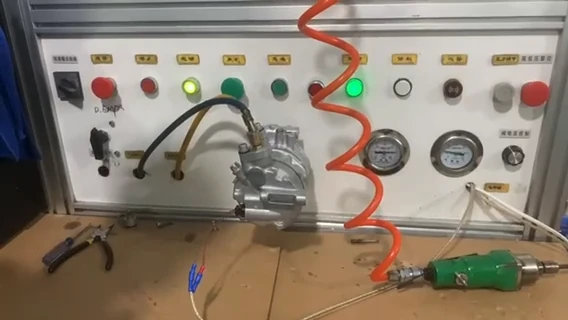
Some repairs need only the valve, so you can add separate AC compressor control valves to the same order. C-Loong’s minimum order is 20 units per model, and different models can be combined in one order. Lead time is 7 to 15 days, depending on the models and quantities. Samples are available for testing.
To plan a range, send us the vehicles or OE numbers you need, the country you sell in and a rough quantity for each model.
References
- Toyota Industries. Variable displacement compressors. https://www.toyota-industries.com/products/automobile/compressor/variable/index.html (accessed 3 November 2026)
- Dave Hobbs, FenderBender. The variables of variable displacement A/C compressors, 1 May 2020. https://www.fenderbender.com/running-a-shop/operations/article/33029875/the-variables-of-variable-displacement-a-c-compressors (accessed 3 November 2026)
- Roy Dennis Ripple, Motor Age. Diagnosing the Ford variable displacement compressor, 28 March 2022. https://www.vehicleservicepros.com/service-repair/underhood/article/21257845/diagnosing-the-ford-variable-displacement-compressor (accessed 3 November 2026)
- MOTOR. Diagnosing Variable Displacement Compressors. https://www.motor.com/magazine-summary/diagnosing-variable-displacement-compressors/ (accessed 3 November 2026)
- MAHLE Aftermarket. Kompaktwissen A/C: vehicle air conditioning. https://www.mahle-aftermarket.com/media/homepage/facelift/media-center/klima/kompaktwissen-ac-fahrzeugklimatisierung-en-screen.pdf (accessed 3 November 2026)
- Hyundai Motor and Halla Climate Control engineers. Study on the Reduction of Fuel Consumption in the A/C System, used Variable Displacement Swash-Plate Compressor and the Performance Improvement by Field Test, SAE 2006-01-0164, April 2006 (abstract). https://saemobilus.sae.org/content/2006-01-0164 (accessed 3 November 2026)
- Volkswagen Group of America. Air Conditioning Does Not Cool and or Compressor is Noisy, Technical Bulletin 87 16 16, 29 August 2016. https://static.nhtsa.gov/odi/tsbs/2016/MC-10107210-9340.pdf (accessed 3 November 2026)
- DENSO Europe. Compressor Control Valve Identification, Product Bulletin 09-AC-2019-EU, October 2019. https://assets.denso-am.eu/production/attachments/AC-Compressor-Control-Valve-Identification-Bulletin-English.pdf (accessed 3 November 2026)
- Audi of America. Air conditioning does not cool and / or compressor is noisy, TSB 87 15 61, 23 April 2015. https://static.nhtsa.gov/odi/tsbs/2015/MC-10120000-9999.pdf (accessed 3 November 2026)
- AutoACForum. 2014 Ram 1500 vdc to fixed displacement compressor conversion, owner’s report, August to September 2023. https://www.autoacforum.com/viewtopic.php?p=27916 (accessed 3 November 2026)
Confirm Fit & Get a Quote
Share your OE number, vehicle model, or a photo — whatever you have. We’ll match the right part and send you pricing, MOQ, and lead time.
Prefer WhatsApp?Chat with us on WhatsApp