
Address
Building 34, Taixing Industrial Zone, Hongxing Community, Songgang Street, Bao’an District, Shenzhen, Guangdong 518105, China



AC Compressor Clutch Replacement: When It Makes Sense and How to Do It Safely
By C-Loong Precision Industry (Shenzhen) Co., Ltd
AC compressor clutch replacement can be the right repair when a vehicle’s A/C is not cooling as expected, the belt-driven compressor pulley still turns, and diagnosis points to the clutch assembly rather than an internal compressor fault. In a workshop, warm air or a compressor that does not come into operation can easily lead to the assumption that the complete compressor must be replaced. That conclusion should wait until the control signal, electrical supply, belt drive and compressor condition have been checked. If the compressor remains serviceable and its clutch can be replaced separately, a clutch-only repair may preserve the usable compressor. This guide explains how to make that decision, identify the correct A/C Compressor Clutches, complete the replacement and verify that the original A/C problem has been resolved.
Page Contents
Product Categories
When Do the Signs Point to an A/C Compressor Clutch Fault?
On a vehicle with a belt-driven A/C compressor, a clutch fault usually becomes a realistic possibility when the A/C is requested, the drive belt and outer pulley continue to turn, but the centre clutch hub does not engage the compressor as expected. The same result can occur when the vehicle is not allowing compressor operation or when the clutch is not receiving the required electrical supply.
The direction becomes clearer when the problem is visibly or audibly concentrated around the clutch assembly. The hub may engage and release intermittently, slip after it engages, make noise near the pulley or bearing, or show signs of overheating around the coil, connector or friction surface. These signs make the clutch a stronger suspect, but they still leave one important question: did the clutch fail on its own, or did another problem place too much load on it?
The next step is to check the control command, connector, belt drive, pulley condition and compressor rotation through the applicable vehicle and compressor procedure. If the command and electrical supply are correct, the clutch assembly itself shows a fault, and the compressor does not show signs of seizure or another non-serviceable condition, the repair can move toward a clutch-only solution.
If the compressor is difficult to rotate, the belt drive is damaged, or the clutch damage may have resulted from an underlying system problem, stop before ordering the part. The next section explains how to decide whether the clutch can be repaired separately or whether the compressor needs a different repair path.
How Do You Confirm Whether the Clutch Needs Replacement or the Compressor Needs Repair?
Once the signs point toward the clutch assembly, first determine whether the fault can be corrected without replacing the clutch. A damaged connector, wiring fault, missing control signal or belt-drive problem can prevent normal clutch operation even when the clutch assembly itself remains usable. If the applicable vehicle or compressor procedure identifies one of these external causes and inspection finds no clutch damage, correcting that cause may restore normal operation.
Replacement becomes the appropriate direction when the clutch assembly itself has a confirmed fault that cannot be corrected through the procedure specified for that compressor. This may include a failed coil, a damaged pulley bearing, a slipping or heat-damaged friction surface, or a hub and retaining arrangement that can no longer operate as intended. Before choosing this route, the workshop still needs to confirm that the compressor itself remains serviceable.
A damaged clutch can also be the result of another unresolved condition. If abnormal compressor resistance, excessive system load, poor airflow or a belt-drive problem may have contributed to the failure, that cause must be addressed before a new clutch is fitted. Otherwise, the replacement part may face the same damaging condition.
Once a clutch-only repair is justified, the next question is whether that compressor design allows the clutch to be replaced separately.
How to Perform an AC Compressor Clutch Replacement
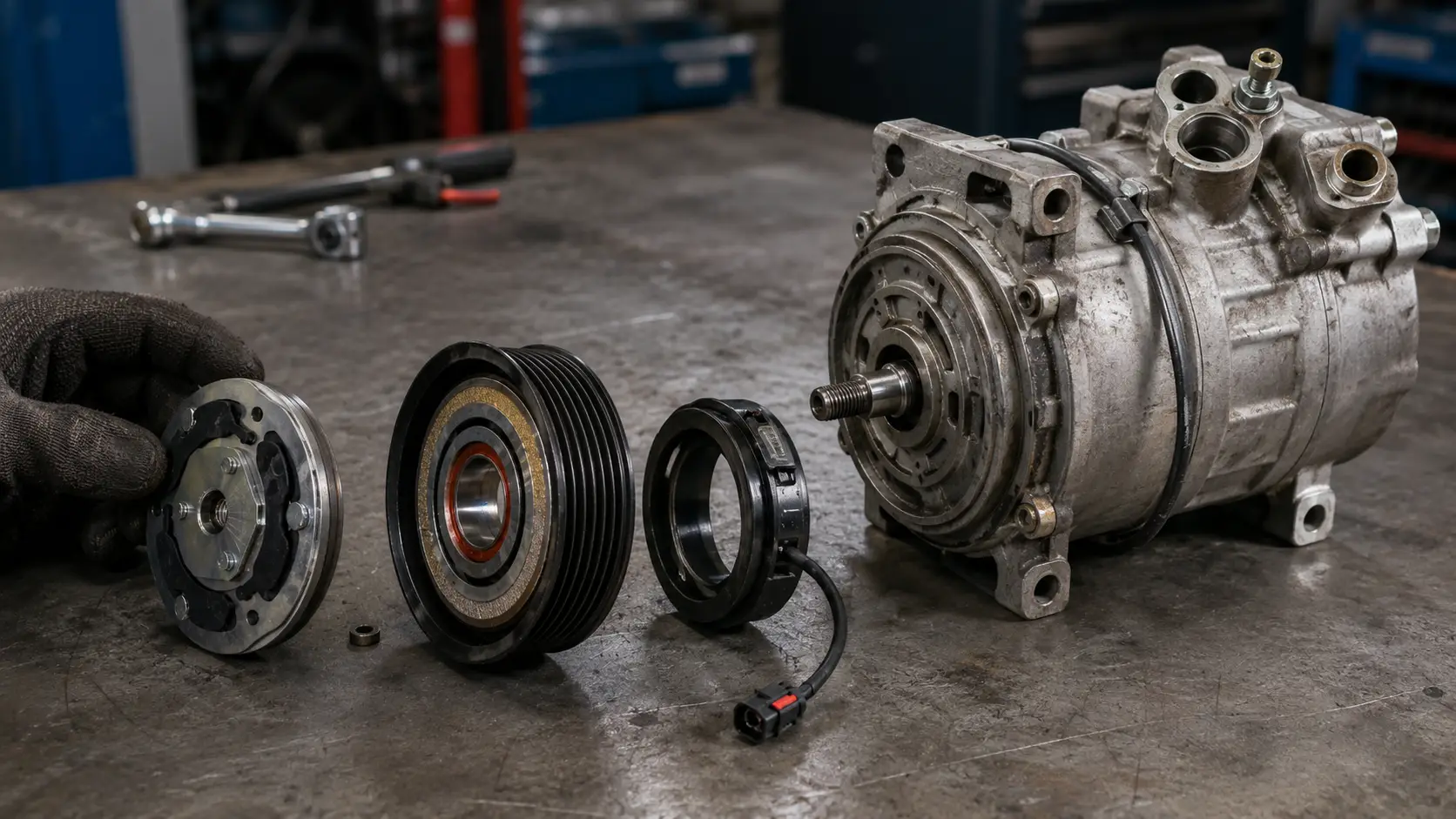
For an AC compressor clutch replacement, begin with the engine switched off. Release the drive belt, disconnect the clutch connector, and remove the original clutch components from the front of the compressor.
Depending on the clutch design, this normally involves removing the hub or armature, followed by the pulley and field coil. Keep the original shims, retainers and hardware together during removal. They may be needed to set the replacement clutch correctly.
Install the Replacement Clutch Assembly
Clean the clutch mounting area before installation and check that the compressor nose is not damaged or heavily worn. Install the field coil, pulley and clutch hub in the correct order for the identified clutch design. Reconnect the electrical lead, refit the belt, and confirm that the belt sits correctly across the pulley system.
The clutch assembly should sit naturally. If the pulley will not slide into place, the hub does not align, or the connector lead cannot be routed safely, stop rather than forcing the parts together.
Use Reference Values That Match the Compressor Family
Clearance and tightening values must match the exact compressor family. For Ford FS-6, Chrysler C-171 and A-590, and Nippondenso 6E171, 10P15, 6P148 and 6C17 compressors, Four Seasons specifies a rotor-to-hub air gap of 0.020–0.040 inches, measured at three points 120 degrees apart. Its procedure also specifies a shaft-nut torque of 155 lb-in.
These figures are not universal. In a separate Four Seasons procedure for Ford FX-15 and specified Toyota Nippondenso compressors, the new-clutch air-gap reference is 0.018–0.030 inches. The difference shows why a clearance or torque value should never be copied from a visually similar compressor.
What Should Be Checked During AC Compressor Clutch Replacement?
Check that the pulley turns freely, the clutch does not rub against nearby parts, and the connector lead is secure and clear of moving components. Do not modify a connector, reuse damaged retainers, or add hardware to make an incorrect clutch fit.
Once the assembly and belt drive are restored, verify that the clutch engages normally and that the original A/C problem has been resolved.
How Do You Verify an AC Compressor Clutch Replacement?
After the AC compressor clutch replacement is complete, first check the belt path, clutch connector and retaining parts with the engine off. The belt should sit correctly on every pulley, the connector lead should be secure, and the clutch assembly should turn without rubbing against nearby components.
Then start the vehicle and allow the A/C system to prepare the compressor for operation. Observe whether the clutch hub engages and releases normally, whether the belt continues to track correctly, and whether the pulley or clutch produces abnormal noise, vibration, smoke or excessive heat. Keep hands, tools and loose clothing away from belts, pulleys and cooling fans while the engine is running.
A single engagement or a short period of cool air is not enough to confirm a successful repair. Test the system under conditions similar to the original A/C problem and confirm that the problem no longer returns. If the clutch still fails to engage, slips, makes noise or the A/C performance remains unchanged, recheck the electrical supply, control command, belt drive, compressor condition and original diagnosis before blaming the replacement clutch.
How Can Compressor Clutches Help Distributors and Wholesalers Build More Repair Business?
Before adding compressor clutches to stock, distributors and wholesalers should first look at the repair requests already coming from their workshop customers. A clutch range is most relevant when workshops regularly see belt-driven compressors where a clutch-only repair has been confirmed as an appropriate alternative to replacing the complete compressor. Demand should be based on actual enquiries, repeat part requests and the vehicles the buyer already serves, rather than on the assumption that every visually similar clutch belongs in stock.
When the repair direction is confirmed, a correctly identified compressor clutch gives the workshop another way to handle an A/C problem without automatically moving to a complete compressor replacement. For the distributor, the value is not simply having one more SKU. It is being able to discuss a repair request with clearer part information and offer a suitable option when the compressor itself remains serviceable.
A clutch enquiry can also lead to a wider A/C parts discussion, but only when the diagnosis supports it. If a clutch-only repair is not appropriate, the buyer may need to review A/C Compressors instead. A separately serviceable control fault may lead to A/C Compressor Control Valves, while an A/C Expansion Valve should be considered only when it is relevant to the confirmed repair scope. These are separate repair directions, not products that should automatically be purchased together.
To support workshop customers efficiently, each clutch model should be recorded with its compressor label, OE or reference number, hub and pulley details, coil connector, original-part photographs and available dimensions. A vehicle description or an overall photograph can help narrow the search, but it does not prove interchangeability. The Auto Care Association’s ACES and PIES standards provide a North American industry example of why structured fitment and product information matters between manufacturers, distributors and other trading partners. They do not confirm a clutch match by themselves, and they are not evidence that every market uses the same system.
When a buyer has identified the models worth exploring, C-Loong can help narrow possible A/C Compressor Clutches using the available compressor and original-part information. For a B2B enquiry, provide the identification details for each model separately, together with the intended quantity. If clearer photographs or dimensions are needed, they can be requested by email after the text enquiry is received.
Control-clutch models may be mixed in one B2B order, with a usual MOQ of 20 pieces per model. Sample availability depends on the model, stock and the actual order situation. Typical lead time is 7–15 days, depending on the model, quantity, stock and order requirements. If an item is in stock and order conditions are complete, dispatch may be arranged sooner. Packaging, labels and any custom-development requirements should be confirmed for the specific project.
References
- DENSO. (2026). AC Compressor Pre-Check Manual.
- Four Seasons. (2022). Compressor Clutch Replacement Procedure: Ford FS-6, Chrysler C-171 and A-590, and Selected Nippondenso Compressors.
- Four Seasons. (2023). Compressor Clutch Replacement Procedure: Ford FX-15 and Selected Toyota Nippondenso Compressors.
- Four Seasons. Compressor Clutch Coil and Bearing Failure Diagnosis.
- Auto Care Association. Product Information Exchange Standard (PIES®).
Confirm Fit & Get a Quote
Share your OE number, vehicle model, or a photo — whatever you have. We’ll match the right part and send you pricing, MOQ, and lead time.